
A machine can have an excellent controller and still behave unpredictably if its wiring is poorly specified. Before adding another sensor or expanding a production line, look at the cables carrying the signals. The right automation cables need to suit the circuit, the environment and the way the machine actually moves.
That question is increasingly relevant to Indian manufacturers. In its September 2026 update, the International Federation of Robotics reported 10,500 industrial robot installations in India for 2025, up 15%. More automation means more connections to specify carefully—not a reason to assume that every flexible cable is suitable for every machine.
Featured photograph: a real automated manufacturing installation photographed by Freek Wolsink on Pexels. It illustrates the application environment; it is not presented as a Tekson project or an endorsement.
Start with the circuit, not the cable colour
Write down what the cable connects: a sensor, actuator, control panel or machine interface. Record the voltage, current, required cores, route length and terminal sizes. Check whether the equipment specifies conductor size, twisted pairs, shielding or a particular communication cable.
A general-purpose control cable is not automatically a substitute for an Ethernet, fieldbus, encoder or servo cable. Follow the connected equipment’s documentation. For wider installation considerations, read our industrial cable selection guide.
Shielded or unshielded automation cable?
Where shielding deserves attention
Variable-speed drives, motors and switching equipment can create electrically noisy environments. Where the equipment or circuit design requires it, a screened or shielded cable helps limit interference coupling into signal circuits. Shielding is part of an electromagnetic compatibility (EMC) design, not a promise that installation errors will disappear.
Tekson’s catalogue distinguishes flexible-core automation cable from screened/shielded automation cable. Its separate shielded control cable range is also worth reviewing when a project calls for that construction. These categories should not be treated as interchangeable without checking the actual specification.
Where an unshielded option may fit
An unshielded cable may be appropriate where the equipment permits it and the installation’s interference conditions are acceptable. Specify it deliberately, rather than choosing it only because it costs less. The circuit requirements and routing arrangement should lead the decision.
Flexible does not automatically mean continuous-flex
A cable that bends easily during installation is not necessarily rated for thousands of repeated movements in a cable carrier. Continuous bending and robotic twisting are different duties. Ask for documented bend radius, motion type, travel conditions and cycle performance before specifying a moving-machine cable.
For example, LAPP’s continuous-flex product documentation expressly identifies cable-chain duty and directs users to motion-selection guidance. That illustrates the need for application-specific evidence; it does not establish equivalent ratings for Tekson products. Tekson’s supplied catalogue does not give a continuous-flex cycle rating for the automation cable discussed here, so suitability for such duty must be confirmed before ordering.
Good routing matters as much as a good shield
Plan signal routes away from interference-producing power circuits according to the equipment manufacturer’s EMC instructions. Use suitable support and strain relief so pulling forces do not reach terminals or shield connections. Keep cable identification readable for the next person who services the panel.
Shield bonding must follow the connected equipment and system design; there is no universal rule to ground every shield at only one end. Siemens’ control-cabinet EMC guidance discusses separating interference zones and making appropriate shield connections. Final routing, bonding and testing belong with a qualified electrical professional.
What Tekson’s catalogue confirms
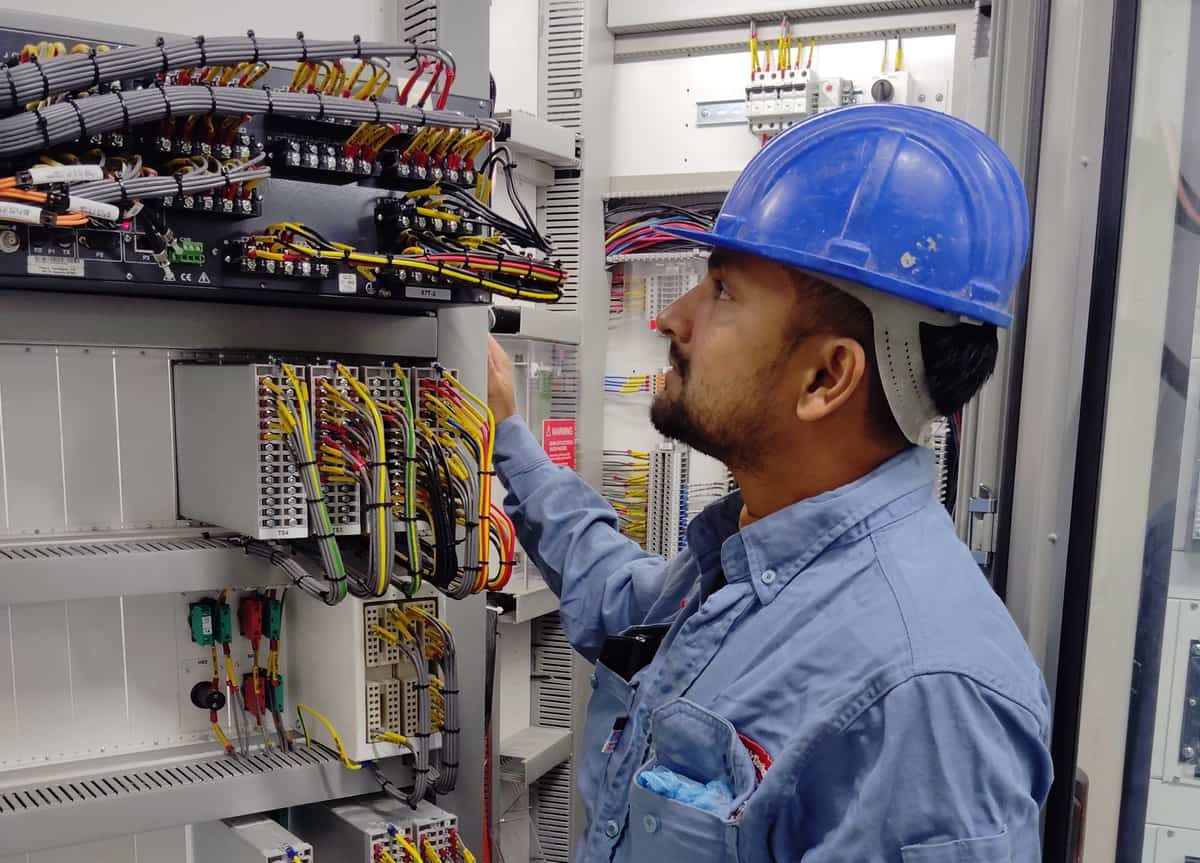
The supplied catalogue sheet lists automation cable in flexible-core and screened/shielded versions, with 7/38 and 14/38 constructions across the combinations shown. Tekson’s official automation cable product page describes 14/38 annealed bare copper options from 2 to 12 cores, in shielded and non-shielded versions.
The product sheet identifies grey PVC construction and, for its screened version, aluminium/Mylar tape with a drain wire. Confirm the exact core count, conductor construction and available length against the current quotation. Do not infer voltage rating, oil resistance, communication speed or robotic suitability from the photograph alone.
A practical automation cable buying checklist
- Confirm the circuit type and the equipment manufacturer’s cable requirements.
- Specify conductor construction, size, core count and terminal compatibility.
- Choose screening only after considering the circuit’s EMC requirements.
- Separate fixed, occasional-flex, continuous-flex and torsional applications.
- Check temperature, moisture, oil, abrasion and other environmental exposure.
- Include route length, support, bend radius, glands and strain relief.
- Agree on identification, inspection and testing before commissioning.
Frequently asked questions
Can shielded cable replace correct panel routing?
No. Shield selection, cable routing, bonding and termination must work together. A shielded cable cannot compensate for every source of interference or an incorrectly made connection.
Can I use any flexible cable in a moving cable chain?
No. Obtain written confirmation of the required movement duty and installation limits. Flexibility alone does not establish a continuous-flex or torsional rating.
What should I send Tekson when requesting a quotation?
Send the application, circuit requirements, conductor size, core count, shielding requirement, length and installation conditions. Include equipment specifications where available.
Specify the connection before you expand the machine
Well-planned wiring makes an automation installation easier to commission, inspect and maintain. Explore Tekson’s cables and wires, then contact the Tekson team with your project specification. Ask for the current product details rather than relying on a generic cable description.